

Community leaders during the PBI Community Exchange in Svalbard

Photo: Handcraft Creative

The power of collaboration

The surprising partnerships at the heart of polar bear conservation

MINS


30 Mar 2026

Polar bear conservation, to borrow a phrase, takes a village. It takes scientists to do research, journalists to report their findings, policymakers to set guidelines and people like you to support research and education. It also requires the involvement of Arctic communities that live on the frontlines of climate change and share a landscape with these large and powerful carnivores.

The challenge is to bring these disparate voices together so they can learn from each other’s perspectives. This is why Polar Bears International (PBI) works to convene community members, scientists, managers and others to share information and advance polar bear conservation.

Churchill leading the way

Churchill, Manitoba is synonymous with polar bears for many, and PBI has been committed to collaborating and working with the community for decades. What began as seasonal visits by PBI staff to observe polar bears has become a year-round presence. 

Education has always been an essential pillar of PBI’s mission, and when it comes to communities like Churchill, that cuts both ways: We are there to learn as well as share. 

In 2022, PBI’s then-Director of Field Programs and Relations Kt Miller began a project to document Indigenous knowledge of human-polar bear coexistence in Churchill, as part of her role at PBI and for her master’s thesis at Royal Roads University — work that was also supported by Environment and Climate Change Canada. Using a storytelling approach, Miller collaborated with Cree Elder and lifelong Churchill resident Georgina Berg to explore how Indigenous people in the region coexisted with polar bears in the past, how they live with them in the present and how they envision coexistence in the future. They are sharing their findings through scientific publications and conferences, and Miller created podcasts of the stories to share with the community using a storytelling approach.
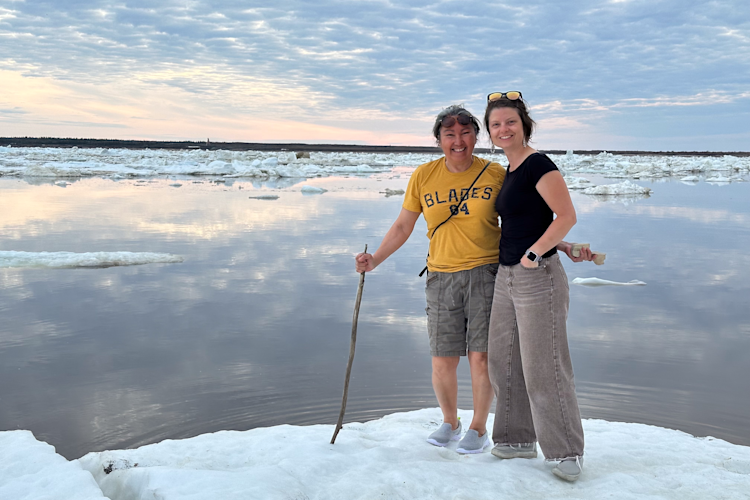
Georgina Berg and Kt Miller on the sea ice of Hudson Bay.

Photo: © Aaron Janzen / Oceans North

Georgina Berg and Kt Miller on the sea ice of Hudson Bay.

In 2019, the town of Churchill approached PBI for assistance and advice in establishing a “bear smart” program to help keep both bears and people safe. Over the last several years, the program has purchased and placed bear-proof garbage containers around town, produced bear-safety videos and other materials and established regular end-of-season debriefs between provincial officials and tour operators. The working group has also recommended changes to the capture and relocation of bears that get too close to human activity.

Sharing skills across the Arctic

Churchill is not the only community where polar bears and polar bear tourism are important elements of life and the economy. Another is Longyearbyen, Svalbard, Norway, where PBI also maintains an ongoing presence. Naturally, both places experience some of the same issues and challenges — but each also has its unique experiences and solutions. 

In 2024 PBI initiated an ongoing information exchange program between the two communities so they can discuss concerns, problems and solutions. Topics range from managing human-bear conflict and tourism to strategies for managing polar bear attractants like garbage in such remote locations.

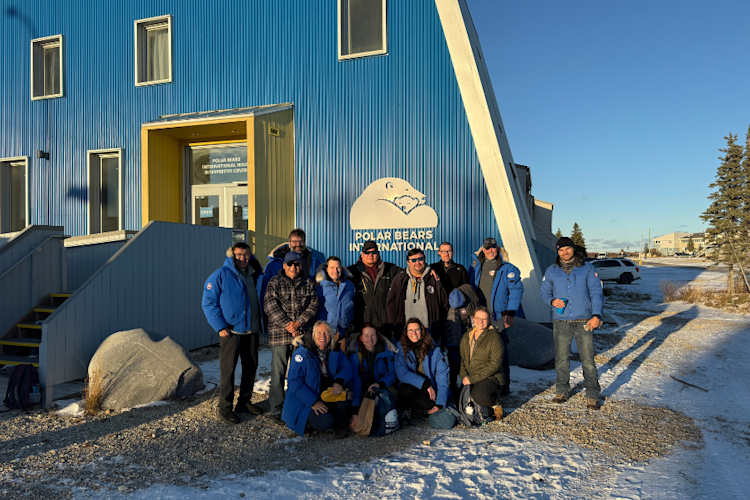
Community leaders from Churchill, Manitoba, Ontario, and Longyearbyen, Svalbard, in front of the Polar Bears International House in Churchill, Manitoba

Community leaders from Churchill, Manitoba, Northern Ontario, and Longyearbyen, Svalbard, gather in Churchill for the first Polar Bear Safe Community Exchange in 2024.

At an exchange held in Svalbard this summer, the inspiration flowed both ways between the Svalbard residents and visiting representatives from Manitoba and Ontario in Canada. The Canadian team shared their deep generational knowledge of bear behaviour, while gaining fresh ideas from Svalbard’s efficient waste management — a key tool in reducing polar bear encounters with people.

But the true value of the exchange is what happens after the participants have returned home. “What we’re really after is helping people create long-term relationships”, says Geoff York, PBI’s senior director of research and policy, and lead on the exchange. “A week from now, a month from now, five years from now, they can reach out to their counterpart in another northern community when a problem arises.”